




The modern smartphone has become the center of enterprise identity. Authenticator apps, SSO sessions, MFA tokens, password managers, and privileged access credentials now live on personal devices, which means a compromised phone is no longer the loss of a device, but the potential compromise of every business system tied to it. For security leaders, the question has shifted from how to secure the device to how to ensure sensitive enterprise data never reaches it at all. That is the gap Secure Virtual Mobile Infrastructure (Secure VMI) is built to close.
BYOD Has Crossed from Convenience to Compliance Risk
BYOD has become a governance and data sovereignty problem as much as a security one. Regulators are increasingly focused not just on whether data is protected, but on where it resides, how it is accessed, and whether it stays within approved organizational or national boundaries. A personal device that touches regulated data is a compliance liability regardless of its security posture, a distinction that matters in government, banking, healthcare, and critical infrastructure. BYOD security has stopped being an IT conversation and become a board-level one.
The Threat Moved to Mobile, and to Identity
Attackers take the path of least resistance, and that path now runs straight through mobile devices and the identities attached to them. Around 83% of phishing websites are built specifically for mobile users, where a smaller screen makes a malicious link far harder to spot and verify. SMS phishing increases about 22% every year, and voice phishing increases roughly 28%.
The most underestimated mobile threat is not malware but identity compromise. Modern campaigns lean on SMS phishing, session hijacking, MFA bypass, credential theft, and social engineering, abusing legitimate workflows rather than software flaws. These attacks leave little trace on the device, and most traditional detection tools never see them. The scale of it is visible in the data: Verizon's 2025 Data Breach Investigations Report found that 22% of breaches started with stolen credentials and 16% with phishing, while 60% involved a human element such as clicking a link or responding to a message.
Multi-factor authentication is no longer the backstop many teams assume. Prompt bombing, session theft, and token hijacking routinely defeat it, while AI is widening the gap further, powering phishing, reconnaissance, and deep-fake-driven social engineering at a scale not previously possible. The device is no longer the real target. The identity behind it is.
MDM vs Secure VMI: Why Device Management Leaves Data Exposed
Most organizations implement a combination of MDM and containerized workspaces, and the logic is reasonable. MDM gives security teams visibility into enrolled devices, enforces policies, controls applications, and enables remote administration. It remains a foundation of enterprise mobile security.
However, MDM was designed to manage devices, not eliminate data exposure. The distinction matters: once sensitive data reaches a personal device, device policy cannot fully control what happens to it. The exposure is not a failure of implementation, it is a limitation of the approach. Remote wipe is usually treated as the ultimate safeguard, yet it only works when the device is online, reachable, and cooperative, and by the time a wipe command goes out, the exposure may already have happened. Controlling the device is not the same as controlling the data. For organizations operating under strict regulatory, sovereignty, and compliance obligations, that distinction is decisive. The alternative is not a better device policy. It is removing the device from the data equation entirely.
Secure VMI: Separation at the Architectural Level
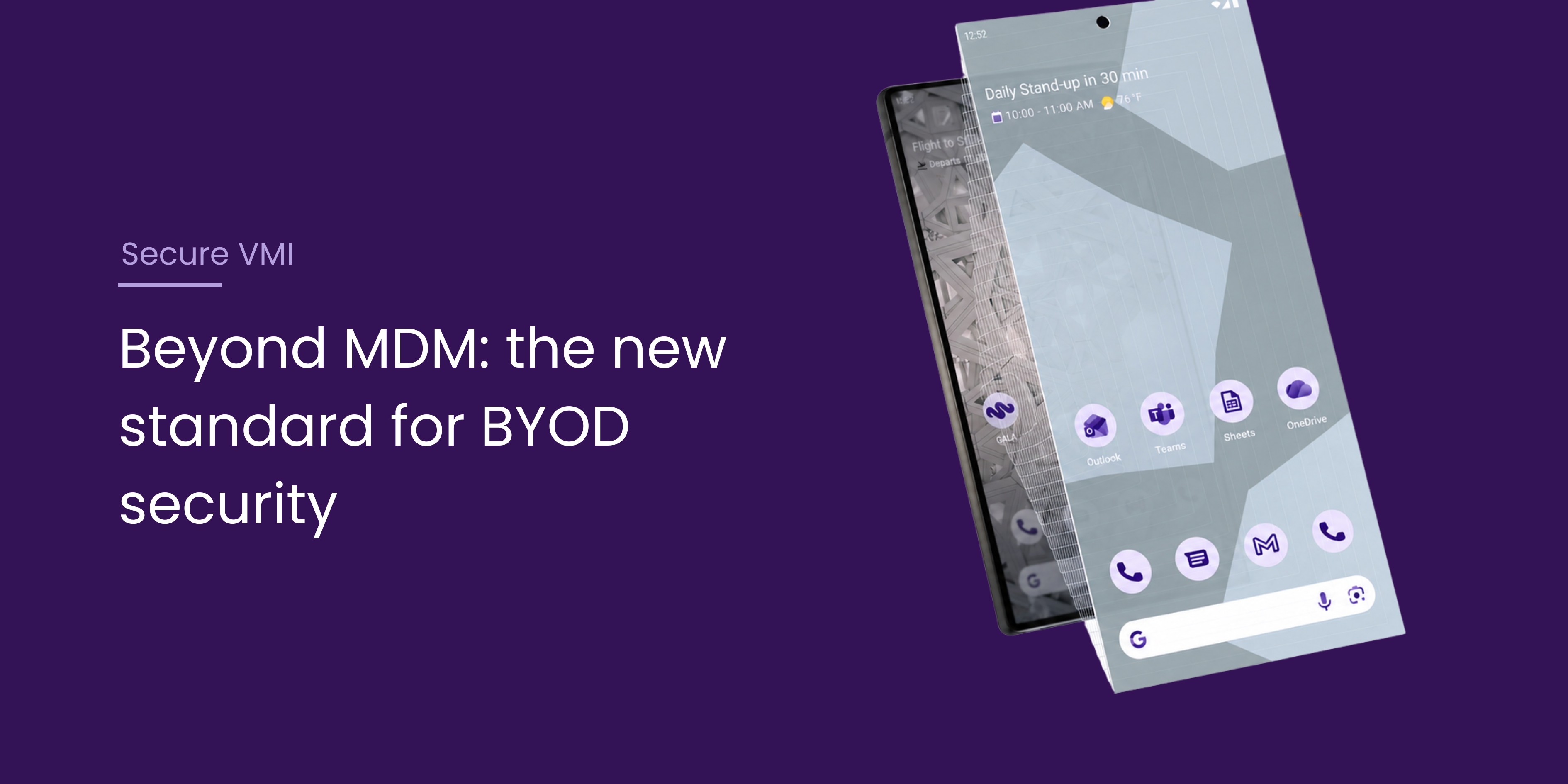
Secure VMI starts from a different premise. Instead of trying to secure the data after it reaches the endpoint, an Android workspace runs inside controlled infrastructure, whether deployed in a public cloud environment such as Azure or AWS, or on customer-managed infrastructure. Applications execute remotely, data stays within the controlled environment, and the user reaches that workspace through an encrypted session that delivers only a secure visual stream to their device.
The device becomes a viewing window rather than a storage location. Nothing is stored locally, no files are downloaded, and no processing happens on the endpoint. That design gives security leaders a straightforward way to test any vendor that claims separation. The questions worth asking are where the data resides, whether the device can store anything offline, and what would be recoverable if the device were fully compromised. In other words, if the phone were examined after use, investigators should not find enterprise files or data stored on it. The only evidence should be that the user viewed a remote session.
BYOD Security When Enterprise Data Never Touches the Device
A device that holds no enterprise data cannot leak it, which changes the nature of a security incident entirely. In a conventional BYOD setup, a lost or compromised phone triggers an anxious investigation into what data might have been exposed, whether files were stored locally, and what must be reported to regulators. With Secure VMI, a compromised device is an access problem, not a data problem. Revoke the session, confirm identity, and restore access. The focus shifts from containment to continuity.
For an employee, a lost device is lost hardware rather than lost enterprise data. Work resumes from another device and the same virtual workspace. For the help desk, the job moves from device recovery and forensic investigation to session management and access restoration. For the security team, centralized session logging produces a clear record of activity, which means questions get answered with evidence instead of assumptions. The resilience gains are just as real. A wiper attack that destroys everything on an endpoint destroys nothing of value when the workspace and data live on server-side. The device gets replaced, access is restored, and operations continue.
There is a sovereignty dimension as well. As regulators place more weight on where sensitive information resides, organizations must demonstrate control over data location, access, and retention. Keeping enterprise data inside controlled infrastructure supports those obligations while simplifying audit, reporting, and governance.
Where Secure VMI Delivers the Most Value
Secure VMI is most valuable where the risk of data exposure is highest: regulated data access, privileged administration, executive mobility, contractor access, and environments where data residency and auditability matter. It is not intended to replace every mobile workflow. It is intended to protect the workflows where allowing enterprise data onto a personal device creates unacceptable security, compliance, or sovereignty risk.
That distinction is important. Traditional BYOD models optimize for broad device flexibility, while Secure VMI optimizes for data separation, centralized control, and evidence-based assurance. The decision is therefore not whether Secure VMI should be used everywhere, but where its architectural separation creates the greatest value.
For regulated organizations, this is a practical way to align mobile access with the sensitivity of the work being performed. Low-risk workflows may continue under existing mobility controls, while high-risk workflows can be moved into a model where enterprise data remains inside controlled infrastructure.
How to Roll Out Secure VMI Without Disrupting Operations
Adoption tends to start with a specific high-risk group, such as privileged administrators, executives, contractors, or teams handling regulated data, and expand once the model proves itself. The strongest early driver is often private. Employees increasingly resist solutions that demand corporate control over a personal device, and Secure VMI offers a cleaner arrangement: enterprise data stays separate from personal data, and the user retains full control over their own apps, photos, and content. Security improves without eroding employee trust.
Integration is typically less disruptive than organizations expect. Secure VMI works alongside existing identity, security, and monitoring tools, fits within broader Zero Trust strategies, and can be introduced gradually rather than as a wholesale replacement of existing investments.
Securing Identity as the New Enterprise Perimeter
The smartphone has become the center of enterprise identity, and the security model underneath it has not kept pace. For organizations under real regulatory, sovereignty, and compliance obligations, that gap is no longer acceptable. Secure VMI closes it by taking the data out of the endpoint equation entirely. Enterprise applications stay inside the controlled infrastructure; users get secure access from any approved device, and a lost phone becomes an access problem rather than a data breach. As mobile threats keep evolving and identity settles in as the new perimeter, the organizations that come out ahead will be the ones willing to revisit the assumptions their security architecture was built on.
Want to find out whether Secure VMI fits your organization? Request a briefing with our team to see how you can strengthen BYOD security, meet data sovereignty requirements, and protect sensitive information without sacrificing productivity or user privacy.